Thank you! Your submission has been received!
Oops! Something went wrong while submitting the form.
Panjab: Puri’s flawed claims on Epstein Files; Gandhi on US-India trade deal says, ‘We have Surrendered’; 300M Participate in Union Protest; Unemployment on Rise. Sikh: Gupta pleads guilty; Pre-partition Gurdwara opens in Lahore—and more stories.

Nikhil Gupta has pleaded guilty to three charges linked to a failed assasination attempt on Sikh separatist Gurpatwant Singh Pannun at a US federal court hearing in New York. 54-year-old Gupta is an Indian citizen and is described as a drug and weapon trafficker. He was arrested in June 2023 in the Czech Republic and extradited to the US. Gupta had hired an assassin to kill Pannun, legal counsel of Sikhs For Justice. The assassin turned out to be an undercover agent of the US Drug Enforcement Administration (DEA). The US had charged Gupta on three counts: murder-for-hire, conspiracy to commit murder-for-hire, and conspiracy to commit money laundering. By pleading guilty, Gupta has accepted that he hired an assassin to kill Pannun, on the orders of Vikash Yadav, an officer with India’s external intelligence agency Research and Analysis Wing (RAW). The US Attorney's Office, Southern District of New York released a statement in which Federal Bureau of Intelligence’s (FBI) Assistant Director Roman Rozhavsky said, 'The US citizen became a target of transnational repression solely for exercising their freedom of speech. The message from the FBI should be clear—no matter where you are located, if you try to harm our citizens we will not stop until you are brought to justice.' India has long denied involvement in the plan but Gupta’s plea punctures that denial. However, Gupta’s pleading guilty would not end the matter. The US could ask for the extradition of former Assistant Commandant in the Central Reserve Police Force (CRPF), Yadav that could point fingers at India's Cabinet Secretariat which oversees RAW’s operation. India claims Yadav has gone rogue and no longer works for CRPF or RAW. Though India also continues to deny involvement in the killing of separatist leader Hardeep Singh Nijjar in Surrey, Canada in June 2023, Gupta told the undercover DEA agent that Nijjar 'was also a target.' This raises questions about India's democratic values and its intelligence overreach in friendly countries. The question now is India’s accountability and institutional control and how it is perceived by the West. Gupta will be sentenced on 29 May and could face up to 40 years in prison (earlier coverage).

Indian Union minister Hardeep Singh Puri decided to clear the air about his name appearing in the Epstein Files by holding press conferences and conducting interviews with pro-government Indian media but failed in his approach. The Indian Leader of Opposition Rahul Gandhi had questioned Puri’s and Prime Minister Narendra Modi’s involvement with the convicted sex offender Jeffrey Epstein in a stormy Lok Sabha (Lower House of Parliament) session. The opposition demanded that Puri resign. Responding to the accusations Puri said that he met Epstein on a few occasions, ‘three or maximum four’ as a part of the delegation of the International Peace Institute in 2008. At that time, Epstein was already convicted of sex offences relating to minors and had pleaded guilty to charges of ‘soliciting prostitution from a minor under a controversial plea agreement’. Puri tried to whitewash it by saying that Epstein had ‘pleaded guilty of a charge of soliciting favors from an underage woman’, which is an oxymoron because an underage woman is a child. The fresh tranche of documents released by the US Department of Justice (DoJ) on 30 Jan show Puri’s exchange of emails with Epstein began in June 2014, with the sex offender writing to Puri about arranging a visit by co-founder of LinkedIn Reid Hoffman to India. Puri wrote a detailed pitch for investment opportunities in India to Epstein and Hoffman. Documents also show Puri met Epstein at his Manhattan townhouse on at least three occasions: 4 Feb 2015, 6 Jan 2016, and 19 May 2017. In a stark contrast to what Puri claimed, on the official website of the DoJ ‘Hardeep’ 430 appears, ‘Hardeep Puri’ 46 times, and ‘Hardeep Singh Puri’ 163 times. The email exchanges also show Puri mentions Epstein’s ‘exotic island’ where he is asking Epstein to ‘have fun’. However, Puri dismissed this as an expression that ‘should not be read meaning into’. Globally the fallout of the revelations of the Epstein Files has seen high profile resignations, including criminal charges against Norway’s former Prime Minister Thorbjørn Jagland. The Epstein Files reveal a sordid and corrupt power nexus between powerful male figures across the world where complacency and knowledge of sexual abuse is ignored to carry on the powerplay (earlier coverage).

On 6 Feb, the US and India released a joint statement outlining the broad understanding reached between US President Donald Trump and Indian Prime Minister Narendra Modi regarding their trade deal. On 9 Feb, the White House issued a detailed fact sheet that included some commitments that were either not mentioned or described differently in the joint statement. On 10 Feb, the White House quietly updated the fact sheet. The changes between the fact sheet and update are: 1) the fact sheet said India would 'commit' to buying USD 500B worth of US products; the update says India 'intends' to buy these goods. 2) The update has deleted India would 'remove its digital services tax'. 3) The update has also deleted India's commitment to importing pulses from the US. However, the update says India has agreed to 'eliminate or reduce tariffs' on US industrial goods and a wide range of agricultural products, including Dried Distillers’ Grains (DDGs), red sorghum, tree nuts, fruits, soybean oil, wine, and spirits. The joint statement had said that red sorghum imports from the US would be limited to ‘animal feed’ but the update does not say that, thus raising concerns about agricultural imports to India. Punjab Agriculture University Vice Chancellor Satbir Singh Gosal is apprehensive about allowing DDGs since it is a genetically modified product which would impact India's poultry and cattle sectors. A farmer unions' alliance Samyukt Kisan Morcha leader Jagmohan Singh said, 'Allowing DDGs is allowing GM technology through the back door which is against the spirit of anti GM-free agriculture policy.' In a response in the Indian Parliament, the union government stated that most Indian states are 19–97% deficient in animal fodder though Panjab, Haryana, and Madhya Pradesh are surplus. The US has offered Bangladesh, India's biggest cotton buyer, a 0% tariff if it switches to US cotton, compromising Indian cotton sales. India’s Leader of Opposition Rahul Gandhi said by agreeing to buying US oil, allowing free flow of Indian data to the US, limiting digital taxes, removing the requirement to disclose source codes, and jeopardizing the textile sector which now faces an 18% tariff from the earlier 3%, the government has surrendered to the US and ‘sold Bharat Mata (Mother India) (earlier coverage).
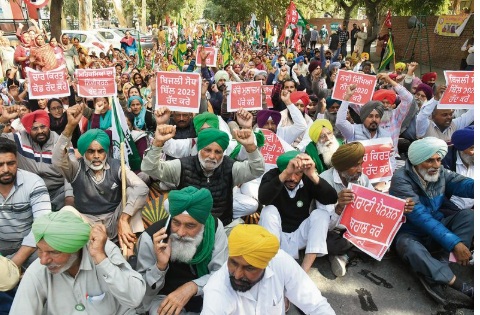
A farmer unions' alliance Samyukt Kisan Morcha (SKM) and Joint Platform of Central Trade Unions had called for a joint nationwide protest on 12 Feb against the anti-farmer, anti-worker, and anti-national pro-corporate policies of the union government. The unions said, more than 300M farmers, agricultural workers, workers, and other groups of employees in 600 districts of India participated in the strike against the four Labour Codes and the Free Trade Agreements between India and the UK, US, and European Union. The charter of demands included withdrawing the Draft Seeds Bill, Electricity (Amendment) Bill, Sustainable Harnessing and Advancement of Nuclear Energy for Transforming India (SHANTI) Act, the Viksit Bharat-Guarantee for Rozgar and Ajeevika Mission (Gramin) Act (rural employment policy), and the Viksit Bharat Shiksha Adhishthan Bill (education policy). Sectors such as coal, electricity, insurance, banking, ports, the manufacturing sector, and services, including transport, were affected in different states. After the strike, the SKM statement said, 'It is one of the largest ever general strikes in the history of independent India and specifically noted for cementing the worker-peasant unity as the backbone of the mass resistance against the corporate policies being vehemently pursued by the government under Prime Minister Narendra Modi.' The Trade Union Coordination Centre statement said, 'The workers in most of the industrial areas in the country, including in many multi national corporations, joined the strike in a big way and organized processions. The defence sector employees held protest demonstrations cutting one hour of work in support of the strike. The railway unions mobilized and participated in solidarity actions.' The Indian National Congress supported the strike, but in Panjab the Aam Aadmi Party (AAP) revealed its double standards. On 11 Feb, AAP posted on X that it opposes India's secret deal with the US and it stands firmly with traders and farmers in every struggle to protect the country and safeguard agriculture. However, that same evening, the Punjab State Power Corporation Limited issued a letter warning its employees of severe disciplinary action if found participating in the 12 Feb strike (earlier coverage).

New data reveals the employment scenario in Panjab has worsened with unemployment rising in the age categories of 15–29 years. In rural Panjab, youth unemployment stood at 22.5%, male unemployment at 19.9%, and female unemployment at 30.7%. For rural and urban combined, male unemployment in Panjab stood at 16.7%, while female unemployment was 28.4%, highlighting a pronounced gender gap. Overall, Panjab's unemployment rate stood at 19.3%, which is higher than the all-India average of 14.3%. Additionally, 743 people have lost their lives in pothole-related accidents across north India, with Panjab emerging as the worst-affected state and recording a staggering 414 deaths between 2020–24. Union Road and Transport Minister Nitin Gadkari said in the Lok Sabha (Lower House of Parliament) that nearly 48% of the 1,556 accidents caused by potholes in the region resulted in fatalities. Gadkari also said that road accidents claimed 1,77,177 lives in 2024. In 2025, the union government spent USD 78M towards maintenance of stretches dotted with potholes. Meanwhile, Union Agriculture and Farmers’ Welfare Minister Shivraj Singh Chouhan said that pollution in Delhi-NCR could not be blamed solely on stubble burning. He said that scientific studies showed that stubble burning contributed no more than 5% to winter pollution, with industry and vehicles being major sources. Furthermore, a serious storage crisis is building up in the Panjab with the harvesting season on the horizon and no space available to store nearly 5 MMT of wheat crop of the 12.5 MMT expected to arrive in grain markets in the coming weeks. Principal Secretary of the Food and Civil Supplies Department Rahul Tewari has also written to Chief Minister Bhagwant Singh Mann asking him to take up the matter with the union government. He said that if the movement of foodgrains is expedited between 15 Feb and 15 Apr, only then space will be created in the warehouses. CM Mann had earlier raised the issue with Union Home Minister Amit Shah and Union Food and Civil Supplies Minister Pralhad Joshi (earlier coverage).
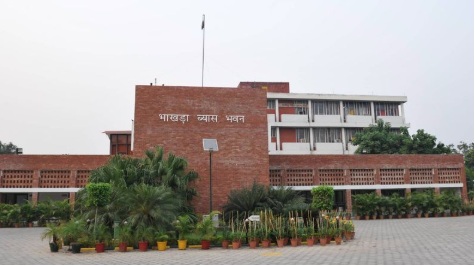
The Bhakra Beas Management Board (BBMB) is planning to undertake a detailed geological assessment of the hills surrounding the Bhakra dam due to increasing incidents of landslides during the monsoon season. BBMB management is onboarding the Geological Survey of India (GSI) to conduct a comprehensive study of the slopes and hill formations around the dam to avoid future risks, especially after the 2025 monsoon season when heavy rainfall triggered multiple slope failures, leading to the blockage of both road and railway tracks connecting Nangal to the dam site. Meanwhile, Punjab and Haryana High Court (PHHC) rejected an affidavit filed by the Greater Mohali Area Development Authority on unauthorized constructions in forest and periphery control areas and imposed interim costs of USD 275 to be deposited in the Poor Patients Welfare Fund of Post Graduate Institute of Medical Education & Research, Chandigarh. The matter relates to alleged illegal commercial and other constructions in and around Siswan forest area in the Sahibzada Ajit Singh Nagar district. Additionally, the National Green Tribunal (NGT) has banned mining in all 85 sites spread across Panjab after an application was moved by the Gahlri village panchayat (village council) in Gurdaspur district. The Council pleaded that since dredging and desilting work were meant for commercial purposes, mandatory environmental clearances were required and ‘lands of the villagers would be adversely affected’ given the village was located downstream. Floods had devastated large tracts of land in Panjab in August and September 2025 and illegal mining had played a major role in the devastation caused. However in Amritsar district, Dera Beas Management is allegedly obstructing the flow of Beas river by dumping sand and reclaiming some portions of the riverbed on the road leading to the dera (sect). Despite flagging the issue to the state government multiple times, no action has been taken yet. Additionally, environment organization Public Action Committee announced the launch of Shivalik Morcha (front), a public campaign to safeguard the Shivalik hills, recognized as Panjab's most sensitive and erosion-prone ecological belt which acts as a natural barrier against soil erosion and a critical groundwater recharge zone for state's plains (earlier coverage).

Three masked gunmen opened fire on a group of migrant mill workers from Bihar and Uttar Pradesh in Moga district, injuring Subodh Kumar and his cousin Ashok. The shooting took place on Moga-Zira road in Khosa Jalal village, when Subodh and Ashok alongwith 12–15 mill workers, were walking towards their room to have lunch. The incident triggered alarm over a possible escalation in anti-migrant violence. With camera rolling, one of the masked assailants fired three–four rounds at the group, which scattered as the trio sped away. Ashok was shot in the leg, and Subodh was grazed by a bullet. Ladi Bhalwan (full name not known), Nirvair Singh, and another unnamed person from the Davinder Bambiha gang claimed responsibility for the attack through a video that went viral on social media. In the video, the shooters are seen brandishing weapons and firing while accusing the migrant workers of not respecting Sikh tenets, not wearing turbans, and obeying Sikh religious practices. They alleged that migrant laborers were disrupting social harmony and law and order in the state. The incident triggered alarm over a possible escalation in anti-migrant violence. Industry bodies warned that such attacks could have serious consequences for Panjab's economy. Such targeting and shooting of migrant workers—considered the backbone of the agriculture sector— is reminiscent of the multiple killings of migrant brick kiln workers in the 1980s. Subodh Kumar said, ‘In the two months that I have been working here, I have hardly spoken to anyone other than my employer and my fellow workers. I just work the whole day and then head to my room. Par ab bahar jaane mein bhi darr lagega (Now I will be scared even stepping out)’. Police claims to have nabbed two assailants but they turned out to be Jobanpreet and his accomplice Akashdeep, unrelated to this shooting incident. In a separate incident, a first-year law student of a private college in Tarn Taran district shot and killed a female classmate in a crime of passion during class. He later shot himself and succumbed to injuries in a hospital (earlier coverage).

Shiromani Akali Dal (SAD) president Sukhbir Singh Badal, Panjab Bharatiya Janata Party (BJP) working president Ashwani Sharma, and Radha Soami Satsang Beas chief Baba Gurinder Singh Dhillon joined the anti-drug awareness walk in Ferozepur led by Panjab Governor Gulab Chand Kataria on 10 Feb. The BJP and SAD top brass has been keeping a distance ever since the alliance of both the parties broke in 2020 over the now repealed pro-corporate farm laws. This was also the first time the dera (sect) chief, considered close to both SAD and BJP, has joined a public rally. Dhillon had also met SAD leader Bikram Singh Majithia twice in jail in recent months. After the foot march, he held a meeting with Indian National Congress (INC)-turned-BJP leader Rana Gurmeet Singh Sodhi. INC alleged Kataria was attempting to help the SAD and its president regain political relevance. Speculation is rife over a potential SAD-BJP alliance ahead of the 2027 assembly elections. Meanwhile, in Amritsar, a 26-year-old youth identified as Akash allegedly died due to a drug overdose on 13 Feb. Akash was a graduate and a football player who had been struggling with drug addiction for some time. His father Ashok Saini who serves as a Home Guard in Panjab Police said, he had admitted his son to de-addiction centers several times to help him recover. Saini alleged drugs are being sold openly and claimed that despite Panjab government's War on Drugs, strict action against drug traffickers is lacking. In less than 24 hours after Saini’s statement, the Amritsar Police Commissionerate not only uploaded video of him retracting his statement on its social media handle, but also uploaded a retired cop’s statement ‘condemning Saini for levelling such allegations’. The police said so far no link to drug use has been confirmed in the matter. Panjab INC chief Amrinder Singh Raja Warring said, 'Merely lodging cases on drugs with police will not end the fight on drugs. The focus should be on treating addicts through a comprehensive de-addiction process.' Concurrently, the Panjab police’s 72-hour Operation Prahar (strike) 2 ended 11 Feb. Police teams conducted raids at 8,278 locations linked to wanted criminals and arrested 3,260 individuals (earlier coverage).
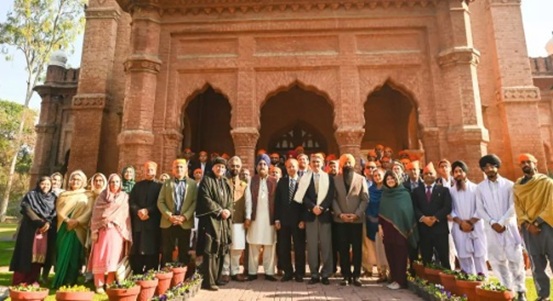
On 13 Feb, a Gurdwara located within the premises of the historic Aitchison College, Lahore, (West) Panjab, Pakistan opened for a religious ceremony for the first time since the 1947 Partition. As no students from the Sikh faith were enrolled at the famous school for the better part of a century, the Gurdwara had remained closed. Current and old students as well as members of the Sikh community attended the kirtan (hymns singing) ceremony as a part of the institution’s 140th Founder’s Day celebrations. The foundation stone of Aitchison College was laid on 3 Nov 1886 to provide education to the royals and chief families of undivided Panjab. Dr. Tarunjit Singh Butalia, an honorary envoy of Aitchison College said, 'It was a nostalgic moment for me in particular to worship at the same place where my father, grandfather, and great grandfather prayed every evening while they were students at Aitchison College.' Harwinder Singh, who led the kirtan ceremony, remarked, 'What a joy to sing these holy verses at this more than 100-year-old Gurdwara which we had never visited, even though we live in Lahore.' The Gurdwara was designed by Ram Singh, the famous Sikh architect of the then Mayo School of Arts now National College of Arts, Lahore. Its foundation stone was laid in 1910 by Maharaja Bhupinder Singh of Patiala who studied at the college between 1904–08. In addition to the Gurdwara, the college also has a pre-partition era mosque and a Hindu temple. Aitchison College Principal Dr. Sayed Muhammad Turab Hussain said, 'We look forward to many more such occasions and hope this promotes communal harmony, mutual understanding, and respect.' Meanwhile, in East Panjab's Mehna village in Moga district, Jagdish Singh and his nephews Shamsher Singh and Rajwinder Singh have donated a piece of land to provide access to the 70-year-old Muslim graveyard that has been lacking a direct path. Additionally, a Muslim family has donated 325 sq. yds. lot of land for the construction of a temple in Jhampur village, Sahibzada Ajit Singh Nagar district after local Hindu residents said there was no space available for a religious place. Mohammed Imran Happy Malik, who donated the land, has also decided to bear the expenses of the temple’s construction (earlier coverage).

Circle-style kabaddi is one of the first sports that boys in Panjab’s villages play. Its appeal lies in its simplicity and it can be played without any equipment. Often the players don’t even wear shoes. The rules of the game are simple and it is played on mud. It is physically demanding which is an added attraction for youth who take pride in building a strong physique. The game—also known as Panjab-style kabaddi—is played at fairs, community gatherings, and local tournaments. The kabaddi season in Panjab runs alongside the winter agricultural calendar. A Dalit (marginalized caste) youth Soni Singh says, ‘Had I not pursued kabaddi, even buying a bicycle would have been a challenge’. Born into a Dalit family in Bhadra village in Panjab’s Mansa district that is dominated by the land-owning upper caste Jat Sikh community, Soni’s father worked as a farm laborer. ‘I too worked on others’ farms to supplement the family income. I once hoped to join the armed forces to escape poverty, but failed the medical due to an eye injury sustained while playing kabaddi,’ he says. After the injury, Soni focused entirely on the sport and moved his family from a two-room house to a bungalow in the village. ‘Kabaddi has given me everything—money, fame, and respect. Today, my entire village takes pride in the fact that I am carrying its name across Panjab and abroad,’ says the 27-year-old who is popularly known as Soni Bhadra. Soni plays for the Non Resident Indian Nakodar Club in Panjab, and has built a career overseas. In the last four years, he has played in New Zealand, Australia, and the UK. In 2025, Shilu Balhara, the son of a marginal farmer in Bahu Akbarpur village, Rohtak district, Haryana was among the highest-paid players at the Toronto-based United Brampton Kabaddi Club. A three-month contract at the club earns star players USD 7.5–8M. As a top stopper, he has also won over a dozen tractors so far. Balhara’s rise reflects the transformation kabaddi has brought in the social and economic standing of hundreds of youth in the region. While kabaddi is breaking caste barriers, the game is also mired in political patronage, corruption, gangsterism, and drug addiction scandals.
Harmeet Shah Singh in The Tribune: Task before Sikh Panth—How to keep Gurbani 'original' in the age of AI.
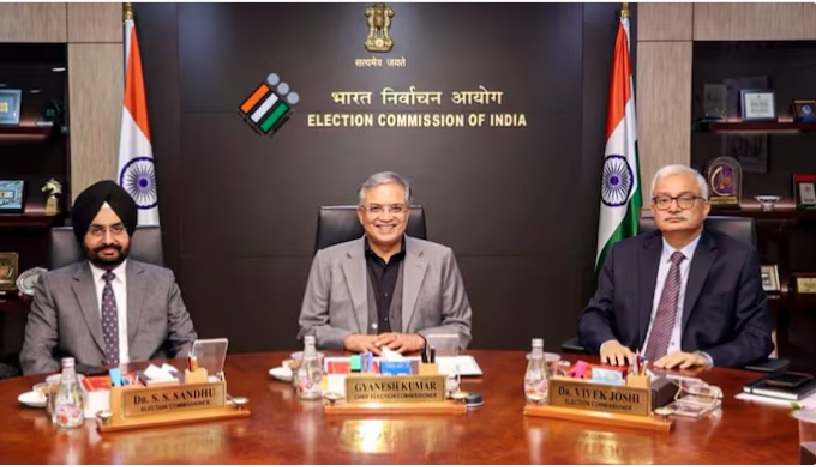
Panjab: Dissent in Indian Election Commission; ED probes GMADA; AAP admits serious accounting impropriety; Student unrest erupts in two private universities. Sikh: US Ambassador visits ‘Darbar Sahib’; SCI remarks on ‘Vande Mataram’ favor Sikhs; Carney’s deprioritizes safety for Canadians—and more stories.

Panjab: Six districts ‘Ultrasensitive’ drug zones; Govt. promises 8% increase in DA; Over 10 cases of kidnapping & extortion of illegal emigrants. Sikh: UK's Johal gets bail; ‘Akal Takht’ expels SAD Leader & 'Granthi'; Truck driver attacked days after US poster; 'Takht Sri Hazur Sahib' marks Modi birthday—and more stories.
