



Thank you! Your submission has been received!
Oops! Something went wrong while submitting the form.
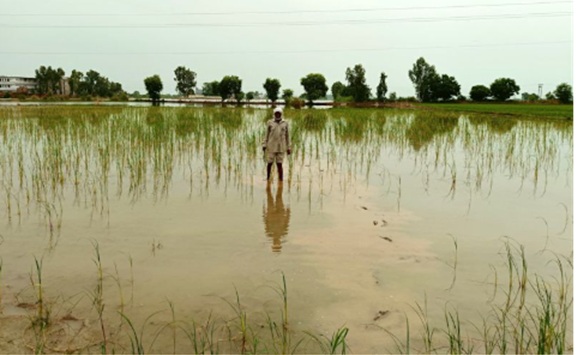
Recent rains in Panjab have left residents of Ajnala district worried with hundreds of acres of paddy along the river Ravi submerged. As farmers began fearing a flood-like situation similar to 2025, the district administration sought to assure them that there won’t be any floods this year and that the overall situation was in control. Deputy Commissioner Dalwinderjit Singh visited vulnerable areas along river Ravi and the Sakki Nullah (rivulet) to review flood preparedness. Dalwinderjit said the Ravi was flowing well within its banks and that there was no immediate threat of flooding in the district. The India Meteorological Department has issued an orange alert (be prepared) for Panjab, Haryana, and Chandigarh, warning of an active monsoon spell between 28–30 Jul. Meanwhile, a Punjab Agriculture University, Ludhiana, study warns that the deterioration of Panjab’s groundwater is faster than previously imagined. Groundwater reserves in the state have been dwindling fast over the past 27 years. The average pre-monsoon water table dipped sharply from 7.8 metres below ground level in 1998 to over 21 metres in 2025. The study points out that Panjab continues to witness an average annual groundwater depletion rate of more than 50 cm, underlining the growing pressure on underground water resources. Additionally, a latest assessment by the union government has identified 111 of Panjab’s 153 groundwater assessment blocks as over-exploited and cautioned against excessive dependence on groundwater for irrigation and dominance of water-intensive paddy cultivation. It said that the state is extracting 56% more groundwater than its annually extractable resources. The Union Minister of Jal Shakti, CR Paatil, said that Panjab’s annual groundwater recharge had been assessed at 18.60 billion cubic metres (BCM) while the annual extractable groundwater resource stood at 16.80 BCM. The district-wise assessment also reveals stark disparities—Sangrur has the highest groundwater extraction level at 310%, followed by Malerkotla (302%), Jalandhar (281%), Kapurthala (243%), Moga (233%), Barnala (219%), and Patiala (209%). Concurrently, a farmer from Thulewal village in Barnala, 39-year-old Satnam Singh Aulakh, has emerged as a successful example of crop diversification by replacing conventional farming with dragon fruit cultivation. The farmer grows the high-value fruit on four acres, earning around USD 12.5K annually while significantly reducing water consumption compared to paddy cultivation (earlier coverage).