



Thank you! Your submission has been received!
Oops! Something went wrong while submitting the form.
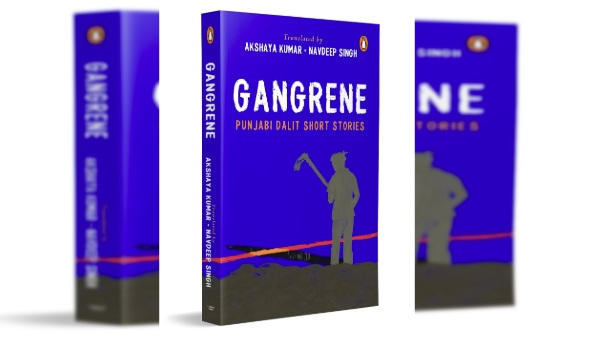
Bringing together 12 stories by various writers and translated from multiple Panjabi dialects and registers and spanning nearly five decades, ‘Gangrene’ is an anthology of short stories that compels one to look more closely at Panjab. Much of Panjab’s dominant cultural imagination centers on agrarian abundance, celebration, valor, and the historical trauma of 1947 Partition. However, this narrative ignores the caste order that sustains the dominant cultural imagination. Home to the highest proportion of Dalits of any Indian state, Panjab has always contained histories that remain at the margins of this imagination. Translated from Panjabi by Akshaya Kumar and Navdeep Singh, Gangrene shifts our gaze towards these histories of margins. Read together, the stories reveal the social foundations of Panjab’s dominant cultural imagination, showing how control over land shapes labor, mobility, faith, leadership, intimacy, and the making of the self. The collection opens with Attarjit’s ‘Bathloo Chamiar’ (slur). Although his name is Sunder, the village knows him as Bathloo Chamiar, reducing him to his marginalized caste identity rather than his personhood. A marginalized caste manual laborer, he agrees to fill a roadside sinkhole for a meagre sum. Even when another laborer points out that the panchayat (village council) has tricked him into accepting far less than the work’s worth, Bathloo says, ‘Our duty is to serve. Whatever the panchayat pays is enough.’ The violence lies not only in the unequal exchange of labor for wages, but also in the way caste transforms exploitation into service and submission into virtue. Attarjit’s second story, Gangrene, is about Jagtar, a Dalit (marginalized caste) man, and Param, an upper caste Sikh woman, who fall in love. They believe that education, love, and the egalitarian ideals of Sikhi might be enough to transcend caste but realise they are not. What makes the story devastating is not simply the failure of love but the gradual dismantling of belief itself. The very institutions and ideals Jagtar turns to for dignity become the sites through which caste is reaffirmed. By the end of the anthology, the meaning of gangrene has shifted. It is no longer merely the decay of body tissue but also a metaphor for the slow corrosion of the social world. The disease spreads quietly, numbing moral perception until exploitation appears as duty, humiliation as tradition, exclusion as common sense and violence as an ordinary fact of life.