
Thank you! Your submission has been received!
Oops! Something went wrong while submitting the form.
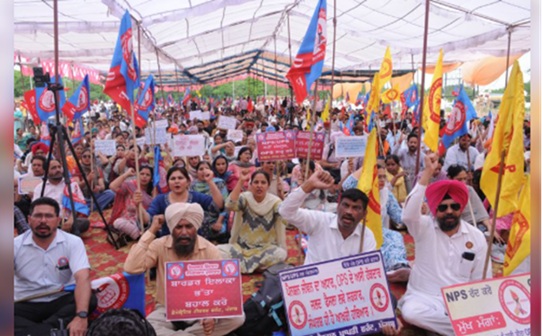
The Panjab cabinet approved a roadmap to dismantle the contractual employment system, paving the way for the regularization of over 65K outsourced and temporary workers across 51 government departments. The cabinet approved the repeal of the Punjab Ad-hoc, Contractual, Daily Wage, Temporary, Work Charged and Outsourced Employees’ Welfare Act, 2016. In lieu, the executive cleared two new legislative frameworks: The Punjab State Outsourced Personnel (Transition to Contractual Engagement) Bill, 2026, and the Punjab Contractual Personnel (Absorption Against Sanctioned Vacancies) Bill, 2026. Chief Minister Bhagwant Mann said the reform returns full dignity to the workers and ensures no contractor stands between the employees and the state. A total of 65,048 outsourced workers fall within the ambit of this decision, with more than 26K workers set to become first immediate beneficiaries. Ironically, the move comes on the same day as several Panjab government employees were protesting and marching towards Chief Minister Bhagwant Mann's residence on 31 May. The Chandigarh Police used water cannons to disperse the government employees who tried to force their way through barricades. The protesting employees have been demanding clearance of dearness allowance arrears (cost of living adjustment), implementation of the Old Pension Scheme, and regularization of contractual computer teachers, among other things. The protesters, including teachers and employees of the electricity department, held a rally in Sahibzada Ajit Singh Nagar before starting the march towards Mann's residence. The protesters alleged that the Aam Aadmi Party had promised to address employees’ grievances before coming to power in 2022 but has failed to fulfill any major demand in the past four-and-a-half years. Additionally, the Punjab and Haryana High Court has held Guru Nanak Dev University’s Vice-Chancellor Karamjeet Singh and Registrar Karamjit Singh Chahal guilty of willfully disobeying judicial directions in a long-running service dispute and sentenced them to a month’s imprisonment. Meanwhile, on the occasion of Menstrual Hygiene Day on 28 May, the Panjab government launched a special menstrual health curriculum for adolescent girls studying in government schools, calling it one of India’s largest school-based menstrual health education initiatives. The program aligns with the Supreme Court of India’s observation that menstrual health and hygiene are directly linked to dignity, education, and equality for adolescent girls (earlier coverage).