Thank you! Your submission has been received!
Oops! Something went wrong while submitting the form.
Panjab: Opposition Targets CM for Appearing Drunk in Assembly; Canadian Report Names India’s Interference; Chadha & Mann to Meet President; India Ranked 157 on Press Freedom Index. Sikh: Akal Takht Summons Speaker Over Anti-Sacrilege Law; Sikh Orgs Mark 40th Anniversary of Khalistan Declaration—and more stories.
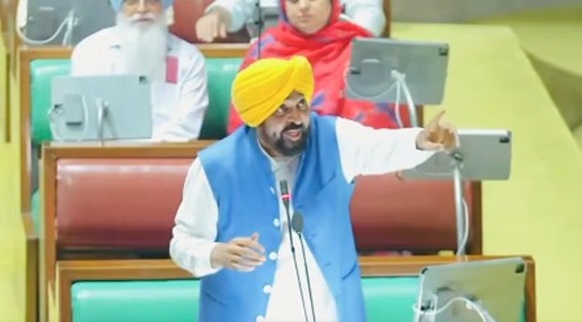
The Panjab government conducted a special Legislative Assembly session on 1 May, Labor Day. In the session, the Aam Aadmi Party (AAP), Chief Minister (CM) Bhagwant Mann, in an unusual fit of rage, objected to Leader of Opposition (LoP) Pratap Singh Bajwa's statement that the eight special sessions convened by the AAP government in the past four years had achieved little and members could not ask public-oriented questions. Mann also objected to how Indian National Congress Member of the Legislative Assembly Sukhpal Singh Khaira was sitting cross-legged and using his phone. Mann’s demeanor, behavior, stammer, and language prompted the Opposition to conclude he was inebriated. LoP Bajwa criticized Mann for being drunk and called for an immediate breath analyzer test for all Assembly members. Assembly Speaker Kultar Singh Sandhwan rejected the demand. Mann’s issues with alcoholism go back to when he was an AAP Member of Parliament from 2014–19. In 2016, sitting next to Mann in the Parliament, fellow AAP MP Harinder Singh Khalsa had submitted a written request to the Speaker of the Indian Parliament stating that he could not bear the nauseating stink of alcohol anymore and requested that his seat be changed. Mann had also appeared drunk at the Bargari Insaaf Morcha (Justice Front) in June 2018. Soon after assuming power in April 2022, on a visit to Takht (throne) Sri Damdama Sahib, Shiromani Akali Dal chief Sukhbir Singh Badal had accused Mann of being drunk. In September 2022, the opposition claimed that while returning from Germany, the Lufthansa flight was delayed as the Panjab CM was deplaned because he was ‘too drunk to walk’. In February 2026, Mann had visited a wellness center in Bengaluru, Karnataka for detoxification. While Mann’s affinity for alcohol is his private issue, appearing inebriated in public, especially in the Assembly, raises questions about his ability to function as a head of state. After the ruckus in the Assembly session, Mann moved a Confidence Motion in the absence of opposition, seeking to reaffirm his government's mandate. The motion was seconded by Finance Minister Harpal Cheema. The Assembly passed the motion (earlier coverage).

The Punjab and Haryana High Court has deferred considering a Public Interest Litigation challenging Panjab’s Jaagat Jot Sri Guru Granth Sahib Satkar (Amendment) Act (JJGGSS), 2026 by 43-year-old Jalandhar resident Simranjeet Singh. The bench questioned the petitioner’s credentials after the Panjab government pointed to past criminal cases registered against him and the suspension of his license to practice law. Panjab Advocate-General Maninderjit Singh Bedi submitted that Simranjeet’s Bar license was earlier suspended amid scrutiny over the genuineness of his academic degree. Meanwhile, taking a different stance from the Shiromani Gurdwara Parbandhak Committee (SGPC), which hailed the recently enacted Act, Sri Akal Takht Sahib (Eternal Throne, AT) acting Jathedar (leader) Giani Kuldeep Singh Gargajj disapproved of the law on 3 May. Stating that the law has been enacted without taking AT into confidence, Jathedar Gargajj has summoned Panjab Legislative Assembly speaker Kultar Singh Sandhwan on 8 May to present his side. Former SGPC General Secretary Bibi Kiranjot Kaur questioned the law, asking, 'Who gives the state the right to interfere between me and my Guru (Guru Granth Sahib, Sikh scripture and charter, GGS)? The government has used colonial terminology Sarbrah (custodian) to reduce the status of the SGPC to merely upkeep of records…Pakistan has the same law because when the British left, they left behind this law. Ask Pakistan how organized crime in the name of the law has increased.' Pakistan commentator Mohammad Hanif echoes this view. Concurrently, the Panjab Police has registered its first case under the new anti-sacrilege law after torn pages of a religious scripture were found in a slum area in Malout, Sri Muktsar Sahib district. The First Information Report against an unknown person was registered 30 Apr night following a complaint by Jangir Singh, a resident of Baba Jiwan Singh Nagar, that torn pages of Sukhmani Sahib Gutka (a smaller version of GGS) were found in Kuchian Mohalla, Malout, an area where around 40–50 households are engaged in scrap-related work. Parallely, AT has rejected a proposal from Mumbai-based Bhanushali Studios, seeking permission to produce a film on the life of legendary Sikh commander Hari Singh Nalua alias Nalwa, citing an existing directive that prohibits films or digital portrayals of historic Sikh warriors (earlier coverage).

The Canadian Security Intelligence Service (CSIS) tabled its report in the Canadian Parliament on 1 May, which said: 'In 2025, the main perpetrators of foreign interference and espionage against Canada remained India, the People’s Republic of China, the Russian Federation, the Islamic Republic of Iran, and Pakistan.' It further said, 'India has cultivated covert relationships with Canadian politicians, journalists, and members of the Indo-Canadian community, to exert its influence and advance its interests. This has included Transnational Repression (TNR) activities, such as surveillance and other coercive tactics meant to suppress criticism of the Government of India and create fear in the community. Given the presence in Canada of supporters of the Khalistan separatist movement, Canada must remain vigilant regarding potential TNR activities.' Meanwhile, a Canadian Broadcasting Corporation documentary titled Corruption, Crime & Cricket Canada shows how, after targeting the sport of Kabaddi, Panjab gangsters now focus on cricket match-fixing. The documentary exposes how individuals claiming to represent the Lawrence Bishnoi gang allegedly threatened national team players in Surrey, British Columbia, in July 2025, forcing support for the rapid rise of Indian-origin player Dilpreet Singh Bajwa as captain. Bajwa, originally from Batala, Gurdaspur district and a former DAV Centenary School student who moved to Canada in 2020, was appointed captain just weeks before the 2026 T20 World Cup, a decision that surprised selectors, the coach, and senior players. Concurrently, Australia deported 15 Indians, including nine from Panjab. The deportees landed at Delhi airport on 30 Apr. The nine Panjab natives recorded their statements with the Panjab Police. Of the nine deported Panjabis, except one woman who 'overstayed' and committed visa norms violations, eight men faced serious charges in Australia. A 41-year-old deportee had a matrimonial dispute and was booked for stalking a child. A 36-year-old deportee had a dispute with his brother and started committing thefts. A 34-year-old deportee had his visa rejected and got hooked on drugs. A 33-year-old deportee went into depression and started using drugs. A 35-year-old deportee lost his wife, his son in Australia, and he served a jail term for several offenses. A 30-year-old deportee's wife got a study visa, but they got divorced (earlier coverage).

On 29 Apr, marking the 40th anniversary of the 1986 Khalistan declaration, hundreds of Sikh activists, led by Simranjit Singh Mann, Daljit Singh, Kanwar Pal Singh, and Narian Singh, marched from Burj Akali Baba Phoola Singh to the Darbar Sahib (Golden Temple) in Amritsar. The participants belonged to the Shiromani Akali Dal (Amritsar), Panch Pardani Jatha, Dal Khalsa, Akal Federation, and the Jathedar Hawara Committee. Outside Sri Akal Takht Sahib (Eternal Throne, AT) Secretariat, they released a policy document Khalistan: Vision, Legacy & Future. The organizations said that the struggle for liberation was rooted in the Gurmat (The Guru’s Way) ideal of Sarbat da Bhala (Prosperity of all). The document covers a brief history of the Khalistan movement, the foundational commitments, the legacy of the struggle, the outlines of their current Dharam Yudh (Principled Battle), the Brahminical Indian state versus the Khalsa Panth (Sikh Collective), the values and character of Khalistan, which the document partly defines as: not the name of a narrow political structure that privileges and particular identity; rather, it will be a new political order grounded in the collective liberation of all oppressed people. Then it lays out the policy directions for future steps. Meanwhile, a special National Investigation Agency (NIA) court in Sahibzada Ajit Singh Nagar convicted and sentenced Inderjeet Singh and Jaspal Singh to five and a half years in prison for hoisting a Khalistani flag in 2020 on a government building in Moga at the instigation of Sikhs for Justice general counsel Gurpatwant Singh Pannun and his associate Rana Singh alias Harpreet Singh. Akashdeep Singh and Jagwinder Singh were also arrested for video-graphing the incident and arranging a hideout for the accused. The punishment for insulting the Indian flag is two years, but Inderjeet and Jaspal avoided strict bail conditions and confessed to their action. They have been released because the time served exceeds the duration of the punishment. The lawyer for the accused Jaspal Singh Manjhpur said Akashdeep and Jagwinder were also out on strict bail conditions, such as USD 10K bail, no social media activities, no statement on the event, and reporting at the local police station twice every week (earlier coverage).

The Aam Aadmi Party (AAP) is going after its seven Members of Parliament who defected to Bharatiya Janata Party (BJP) on 24 Apr. On 25 Apr, the Panjab government withdrew cricketer-turned MP Habhajan Singh’s Y-category security cover provided by the Panjab police. Shortly thereafter, the union government stepped in to provide security through the Central Reserve Police Force, with personnel now stationed outside his residence in Jalandhar. On 1 May, the Punjab and Haryana High Court directed the Panjab government to ensure no physical harm was caused to MP and his family while they were in the state. On 30 Apr, the Punjab Pollution Control Board (PPCB) raided MP Rajinder Gupta's Trident group’s Dhaula unit in Barnala district over issues of water and air pollution. Reacting to the PPCB action, BJP Panjab working president Ashwani Sharma termed the raid 'deplorable and politically motivated'. On 2 May, the Panjab police filed two First Information Reports (FIRs) under non-bailable sections against MP Sandeep Pathak. Pathak was seen leaving his residence in Pandara Road, New Delhi, and has since been ‘untraceable’. Pathak supposedly has dossiers on all the AAP legislators in Panjab. Meanwhile, another defected MP, Vikramjit Singh Sahney, has launched a scathing attack on the Panjab government, saying that union government schemes bearing the PM (Prime Minister) prefix are being blocked in the state. Responding to the gaddar (traitor) moniker AAP has associated with the seven MPs, he said blocking these schemes is the real gaddari (betrayal) with Panjab, Panjabis and Panjabiat. MP Raghav Chadha has termed these moves by the Panjab government as vendetta and is meeting President Droupadi Murmu on 5 May to raise concerns over the alleged misuse of state machinery in Panjab. AAP has been seeking the Right to Recall (removal from Parliament) of the defected MPs. Panjab Chief Minister Bhagwant Mann is also meeting President Murmu to discuss the legal and constitutional aspects of MPs changing their party. Panjab BJP president Sunil Jakhar termed the move as nothing more than 'desperate attempts by AAP to prevent its party from breaking apart' (earlier coverage).

Under the US War Powers Act of 1973, the US President can deploy troops to respond to an 'imminent threat' but must receive Congressional approval within 60 days to continue military operations. 1 May was the day President Donald Trump needed to get Operation Epic Fury on Iran approved. Instead, he chose to send a letter to Congress leaders that hostilities with Iran have 'terminated', suggesting that the 60-day deadline to seek approval was no longer applicable. Meanwhile, the US blockade of the Strait of Hormuz continues and Iran's new proposal asks the US to end the war on all fronts, including Lebanon, lift the naval blockade, withdraw forces, and establish a new governing mechanism for the Strait. However, dozens of tankers reportedly continue to slip through the US blockade. These ships stay within the nautical limits of Iran, Pakistan, and India without entering international waters, and move from Iran's Kharg Island to India’s Mumbai. Still, these are a fraction of the Strait’s normal traffic. Additionally, fertilizer producers are currently using vessels locked in the Strait as storage, ready to move once the waterway reopens. But with the route still essentially closed, laden ships cannot exit and empty ones aren’t coming in for refills. A senior analyst at a global consultancy Pranshi Goyal says, 'The longer this situation lasts, the greater the risk that producers are forced to shut down because storage fills up and there is simply nowhere left to put the product.' However, on 28 Apr in Panjab, nearly 15K seed and fertilizer dealers across the state suspended operations in an India-wide protest against the union government policies. The dealers allege that they are being coerced into 'mandatory bundling' practices and are being unfairly held liable for the failure of government-supplied seeds. The Agri Inputs Dealers Association alleged that fertilizer companies are conditioning the supply of essential Diammonium Phosphate (DAP) on the mandatory purchase of nano urea and nano DAP. Though India is rapidly promoting nano urea and nano DAP, a Punjab Agricultural University study in 2024 showed a significant decrease in wheat (up to 21.6%) and rice (13%) yields and also a decrease in protein content of the grain when nano urea was used as a full substitute for conventional urea (earlier coverage).
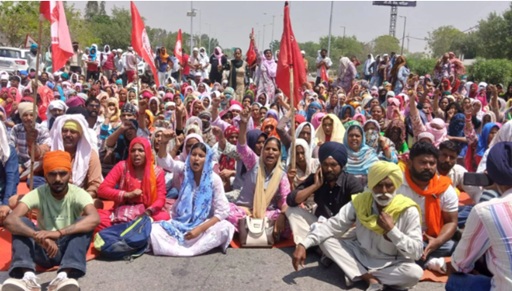
Amid mounting legal and environmental concerns, the Panjab government withdrew the Punjab Unified Building Rules, 2025, on 27 Apr restoring the earlier regulatory framework. The policy aimed to allow contentious provisions, such as relaxations for higher vertical expansion, including stilt-plus-four-floor constructions. This marks the second major rollback by the Housing Department after the withdrawal of the Land Pooling Policy. Both initiatives were designed to generate quick revenue for the cash-strapped state government and support its ambitious spending plans. The petitioners, including 93-year-old Harbinder Singh Sekhon and 61-year-old Jasinder Singh Sekhon, argued before the Punjab and Haryana High Court that the rules would lead to 'haphazard raising of buildings' and unchecked densification of residential areas. They also contended that residents were not adequately consulted during the formulation of the policy. Alongside, the Panjab government has proposed a resolution approving a 15% increase in minimum labor wages after 13 years of work, extending the benefit to all registered workers in both government and private sectors. The resolution came on the back of recent labor unrest among workers—mostly women—at Sportking India Limited’s unit in Bathinda. The agitation began on 19 Apr when employees protested outside the factory, alleging low wages and poor increments. The management then sought a week’s time to address the concerns, following which the protest was temporarily withdrawn. However, the meeting between workers, management, and district administration failed to yield a resolution on 26 Apr, tensions resurfaced and employees began protesting again. The Panjab government moved swiftly and fulfilled the demand, lest it lead to larger statewide protests. The fear of the protests spiralling came from massive April protests in Gautam Budh Nagar, Uttar Pradesh which lasted about a week. Labor activists have criticized the wage hike as insufficient amid rising costs, calling for a 30% increase to match Haryana's wages. Meanwhile, Panjab recorded its highest-ever Goods and Sales Tax (GST) collection of USD 314M in April. It was a 66% growth in GST from 2025. Panjab also recorded a significant 23% surge in Value Added Tax collections in April 2026, adding nearly USD 24M to the state exchequer (earlier coverage).
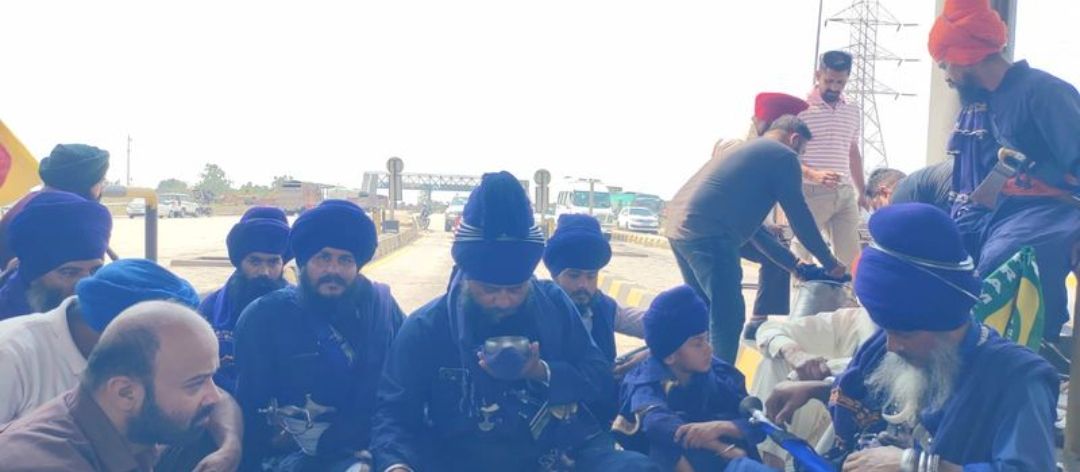
A bomb blast ripped through a section of the Dedicated Freight Corridor (DFC) railway track near Bathonia village, between Rajpura and Shambhu in Patiala district, on 28 Apr night. The explosion triggered a security alert across Panjab and neighboring Haryana. A man—allegedly attempting to plant an improvised explosive device—died at the spot. The police later identified him as Jagroop Singh from Panjwar village, Tarn Taran district. Senior Superintendent of Police Varun Sharma said the explosion caused some damage to the track. Jagroop's family has refused to take his body or give consent for a post-mortem. Police say Jagroop was associated with jailed Khadoor Sahib Member of Parliament Amritpal Singh. Police have identified the founder of a closely run group Chalda Vaheer Chakarwarti, Attariye, Pardeep Singh Khalsa, as the mastermind of the plot. Pardeep used to send like-minded individuals to Malaysia for training and assign them to terror activities. Jagroop had been to Malaysia several times. The police have arrested four individuals who were running a Khalistani terror module that was receiving support from Pakistan’s Inter-Services Intelligence. Union Minister of State for Railways Ravneet Singh Bittu visited the blast site and reviewed the security situation along the DFC. The minister expressed serious concern over the repeated incidents targeting railway infrastructure in Panjab and assured strict, immediate measures to strengthen safety and monitor railway tracks. A blast had occurred a few hundred meters away on the same DFC railway track on 23 Jan. The ploy seems to be to create a sense of terror in Panjab, especially among the trading community. Meanwhile, the ongoing agitation against the Himachal Pradesh entry tax intensified on 2 May, after the Nihang Singhs (traditional Sikh warriors) joined the stir and issued a seven-day ultimatum to the Panjab government to impose a reciprocal tax. Nihang leader Baba Achchar Singh said, ‘This is not merely a tax issue but a matter of dignity and rights of the people of Panjab.' The announcement comes two days after Sri Akal Takht Sahib (Eternal Throne) acting Jathedar (leader) Kuldeep Singh Gargajj termed the entry tax of Himachal as Jaziya (a tax during the Mughal rule on non-Muslims) (earlier coverage).

India had placed the Indus Waters Treaty (IWT) in 'abeyance' after the Pahalgam terror attack in April 2025, which killed 26 people. New Delhi and Islamabad continue to hold divergent interpretations of the agreement. For India, the treaty remains in abeyance; for Pakistan, it is still 'fully operational and effective'. On World Water Day on 22 Mar, which coincides with the eve of Pakistan Day, Pakistan’s President Asif Ali Zardari said, 'India’s decision to place the treaty in abeyance, disrupt hydrological data-sharing, impede agreed mechanisms, undermines both the letter and spirit of a long-standing international agreement that has governed equitable sharing of the Indus river system for over six decades.' Between India and Pakistan, the eastern rivers—Satluj, Beas, and Ravi—have an average annual flow of 33 MAF, and the western rivers—the Indus, Jhelum, and Chenab—have an average flow of 135 MAF. To utilize its share of water mandated under IWT and increase storage capacity, India has completed sediment flushing at the Baglihar, Salal, and Dulhasti hydroprojects on the Chenab and accelerated the construction of hydro infrastructure. Work on projects such as Pakal Dul (1K MW), Kiru (624 MW), Kwar (540 MW), and Ratle (850 MW)—all on the Chenab River—has been accelerated. Other hydroelectric projects, such as Sawalkote (1,856 MW), Bursar (800 MW), Kirthai I (390 MW), and Kirthai II (930 MW), are also making progress. Jammu and Kashmir may see a 46% increase in installed hydropower capacity by the end of 2026. The impact of climate change on the Indus basin is also intensifying. Between 2001 and 2021, the basin experienced a net loss of 25% in perennial snow and ice cover. As a result, a widening gap between water demand and supply and strained bilateral ties risk exacerbating tensions between the two South Asian nuclear powers. Meanwhile, Reporters Without Borders ranked India 157th out of 180 countries in the 2026 World Press Freedom Index. In 2025, India ranked 151. The citation said: ‘India’s media has fallen into an 'unofficial state of emergency' since Narendra Modi came to power in 2014 and engineered a spectacular rapprochement between his party, the Bharatiya Janata Party, and the big families dominating the media’ (earlier coverage).

Panjabi singer-actor Daljit Singh alias Diljit Dosanjh briefly halted his performance during his ongoing Aura Tour in Calgary, Canada, on 3 May after audience members were seen waving pro-Khalistan flags. Upon noticing the flags, Diljit asked those involved to leave. Diljit said he has consistently used every platform to highlight Panjab's issues and rejected criticism over his appearance on the television quiz show Kaun Banega Crorepati (modeled on Who will be a Millionaire?) and bowing to the host Amitabh Bachchan in 2025 after the Panjab floods. Bachchan has long been accused of fanning the 1984 Sikh genocide through provocative sloganeering. Diljit said his intent was to represent Panjab, not personal promotion. He said, 'My job is not to do charity. But whichever platform I go on, I always talk about Panjab. We often say the national media doesn’t talk about Panjab. I went everywhere, including on that channel, for the sake of Panjab. If you still have an issue, jinne jhande dikhane dikhai challo (keep waving how many flags you want to).' Diljit has also been criticized for meeting and bowing to Indian Prime Minister Narendra Modi. However, the question is if an Indian artist gets a call from the PM’s office, can the artist refuse? Especially after a successful, high-earning world tour, when the state can unleash the Enforcement Directorate, the Income Tax Department, as it does against political rivals. Instead of making music, the artist will spend years in court. Recently, Diljit also appeared on The Tonight Show Starring Jimmy Fallon, where he spoke about Guru Nanak Jahaz, also known as the Komagata Maru incident. Talking about 1914, when Canada didn't allow the ship to dock, he said, ‘Now 55K Panjabis assembled at a stadium in Vancouver, 2 km from the spot. We are here!' Parallelly, during King Charles III's official visit to New York City, the son of Panjabi and Indian immigrants, Mayor Zohran Kwame Mamdani, said that if given a private meeting, he would ask the King to return the Kohinoor diamond to India. This raises a question on colonial legacy. The Kohinoor belonged to the Maharaja of greater Panjab Ranjit Singh who ruled from Lahore. When returned, where would it go? To India, to Pakistan, or to East Panjab (earlier coverage).
Parneet Virk in Baaz: The Surrey Nagar Kirtan is not a marketplace.

Panjab: Laborer names Cheema in dying declaration; Power crisis; Court restrains Majithia & Khaira; Sekhon joins AAP & Sidhana joins WPD. Sikh: DHS accused of bigotry over Mr. Singh poster; Pakistan stops pilgrims; Canada mishandles protest—and more stories.

Panjab: Govt. employees on strike again; State moves SCI for DA Dues; Justice Mishra takes oath as Chief Justice; SAD targets Dr. Gurpeet. Sikh: Youth alleges torture & assault; Long delay in SGPC elections; Relief for Nepal flood victims—and more stories.
